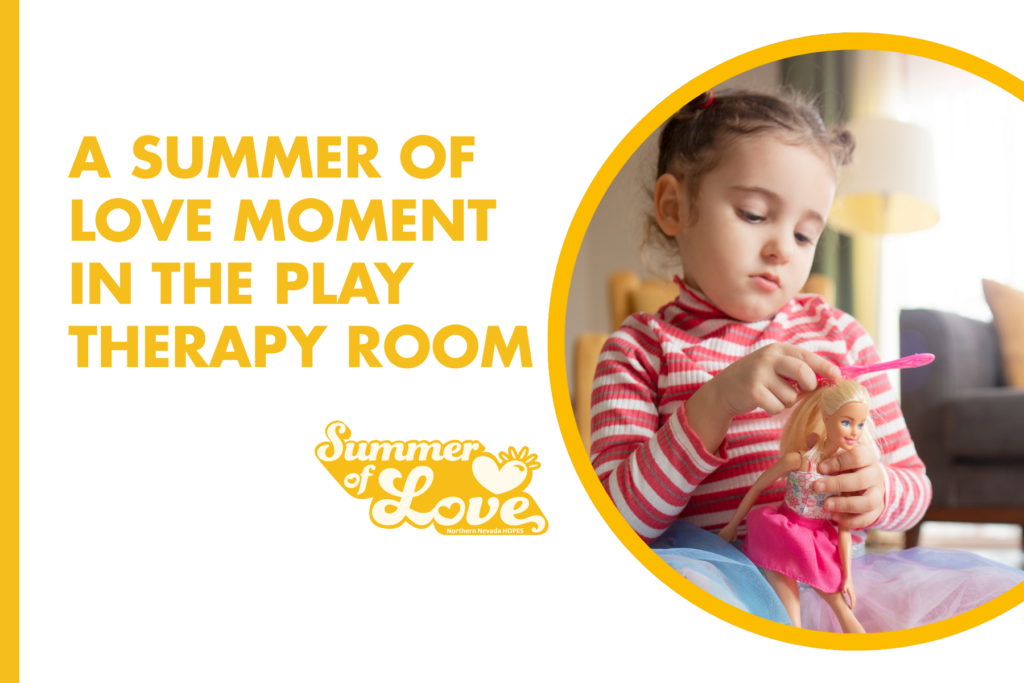
Emily came to Northern Nevada HOPES after experiencing significant instability and loss—more than many children her age should ever have to endure. Like many kids, she didn’t yet have the words to explain how unsafe the world felt. Instead, she showed it through play.
At the HOPES 5th Street Clinic, Emily met regularly with our behavioral health team in the Play Therapy Room—a carefully designed space where children can express their feelings through toys, storytelling, and imagination. In play therapy, play is a child’s language, and our trained therapists listen closely for meaning, patterns, and signs of healing.
Week after week, Emily returned to the dollhouse. Every session told the same story: the grown-ups disappeared, the children were left alone, and the house fell into disarray. While the play looked repetitive, it reflected her lived experience—and showed just how guarded she still felt.
Then one day, something changed.
Emily came in and began her play as she always did. But this time, the grown-ups didn’t leave. The children weren’t alone. The house stayed calm.
It lasted maybe ten seconds.
Those ten seconds mattered.
In play therapy, moments like these signal something powerful: a child beginning to imagine safety, to feel what stability could look like, and to trust—even briefly—that care might stay.
Emily’s progress didn’t happen overnight, and it didn’t happen alone. It was supported by consistent, compassionate care at HOPES—by therapists trained in trauma-informed play therapy, by a care team working alongside her caregivers, and by a clinic environment rooted in dignity, belonging, and community.
In the weeks that followed, caregivers noticed meaningful changes. Nightmares became less frequent. Transitions grew easier. Emily was less “on guard,” able to relax in ways she hadn’t before.
This is what our Summer of Love is all about: celebrating the small, quiet moments where compassion leads to connection—and connection opens the door to healing.
Sometimes love doesn’t arrive loudly.
Sometimes it shows up in a play therapy room,
in a dollhouse,
in ten seconds of calm
that say, You are safe. You belong. And we are here.